
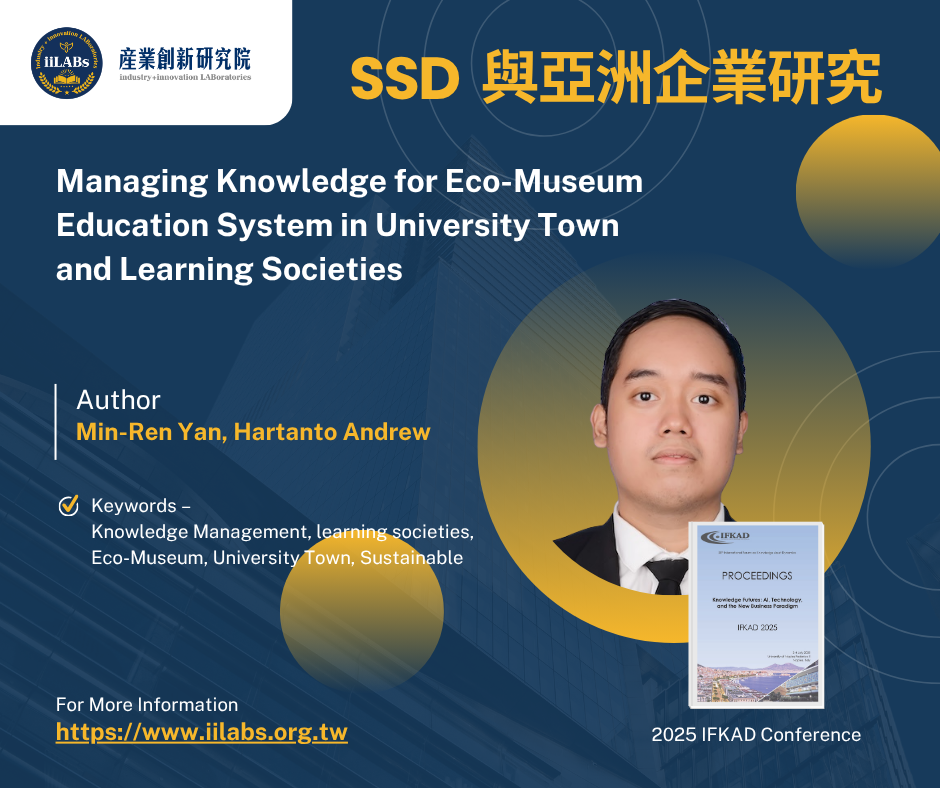
📙論文名稱:
Managing Knowledge for Eco-Museum Education System in University Town and Learning Societies
📙刊登處:2025 IFKAD國際學術研討會
📙作者姓名: Min-Ren Yan, Hartanto, Andrew
論文摘要:
In the globalization era, sustainable development is becoming increasingly important to ensure that economic growth and social development do not damage the environment or compromise the well-being of future generations. Sustainable development has an important role in education because it is the foundation for holistic and responsible human development (Sterling, 2010; UNESCO, 2017).
Educational institutions play an important role in educational development. However, local communities also play a crucial role in building sustainable education. Active community involvement can strengthen the learning process by providing relevant context to support students in understanding and addressing specific environmental challenges in their area (Tilbury & Wortman, 2004). In addition, effective knowledge management is essential to bridge the gap between formal education and community engagement, ensuring that local knowledge is systematically documented, shared, and used to address sustainability challenges (Enes et al., 2024, Rowley, 2000).
The development of technology has brought significant progress, including the emergence of the concept of the eco-museum. An eco-museum is a museum that focuses on local identity with the active participation of the local community and aims to improve the welfare of the community. In the early 1970s, Georges Henri Rivière and Hugues de Varine first developed this concept in France. The application of the eco-museum (ecosystem museum) concept has spread globally, and Taipei is one of the cities that has successfully implemented it. The Taipei Eco-Museum preserves and exhibits the city’s cultural and natural heritage in the context of people’s daily lives, making it a living museum (Yan & Wu, 2024). Management knowledge plays a vital role in the success of the eco-museum, ensuring the integration of local identity, community participation, and technological advancements to ensure sustainability (Harrison, 2005; Macleod, 2018).
In Taiwan, National Taiwan University exemplifies the integration of history, culture, and urban development through the eco-museum concept (Department of Cultural Affairs Taipei City Government, 2022; Department of Information and Tourism, 2023). Management Knowledge guarantees the preservation and accessibility of cultural and historical narratives to a diverse range of stakeholders, including students and local communities (ICOM, 2019). Meanwhile, National Chengchi University (NCCU) has the potential to adopt and expand the eco-museum model. By leveraging its strengths in social sciences, business, and communication (NCCU, 2024; QS World University Rankings, 2024), NCCU can leverage the Cultural Ecosystem Service Innovation (CESI) framework to promote interdisciplinary collaboration and continuing education (Yan, 2021; SSD Alliance, 2024). Through knowledge management, NCCU can serve as a hub for the collection, analysis, and dissemination of knowledge, supporting the eco-museum concept and creating a “university town” that integrates research, education, and community engagement (Mårtensson, 2000; UNESCO, 2021;National Chenghi University, 2024). Through the collaboration between Maokong, Taipei Zoo, and NCCU, NCCU can pioneer solutions for sustainable cities and serve as a model for other regions. This research aims to analyze the application of the CESI framework in this context, focusing on how management knowledge enhances collaboration and sustainable outcomes.
Traditional perceptions about museums include their acquiring, preserving, researching, and exhibiting cultural heritage for educational purposes (ICOM, 2017). However, eco-museums expand this role by emphasizing local participation and community welfare. In Taipei City, Beitou District successfully implemented the eco-museum by preserving cultural heritage, fostering sustainable tourism, and bringing economic and social benefits to the local community (Yan & Wu, 2024). Knowledge management has been central to this success, enabling systematic documentation and sharing of cultural heritage, as well as encouraging innovative solutions to address challenges in sustainable tourism (Hopkins, 2020).
The UNESCO Education for Sustainable Development (ESD) Program highlights the importance of transforming education and society to address global challenges. Formal, non-formal, and informal education are the keys to integrating to support sustainability (Fadeeva et al., 2014). Management knowledge becomes a bridge in this entire system, ensuring the smooth flow of information and skills in various educational contexts (Rowley, 2000). In this research, cultural values studied through Koentjaraningrat's seven cultural elements offer a framework for understanding how cultural knowledge can be a source of knowledge managed to support eco-museums and education (Koentjaraningrat, 1985; Sumarto, 2019).
The existence of a university town highlights the transformative role of universities in making growth in local economic, social, and cultural. Universities serve not only as educational institutions but also as catalysts for innovation and infrastructure development, contributing to the city's sustainability through collaboration and cooperation among the government, universities, and society (Ave, 2016). Effective knowledge management ensures that academic research and community engagement contribute directly to sustainable urban development and cultural preservation (Mårtensson, 2000).
The focus of this research was on NCCU, Maokong, and Taipei Zoo because of their unique values and potential for collaboration. The authors collected data through observation and secondary sources such as journals, books, and official documents, guided by the CESI framework and qualitative descriptive methods for analysis. Preliminary findings highlight the critical role of active community participation and effective knowledge management in fostering sustainable education systems through eco-museums. Collaborative efforts between three locations demonstrate how integrating cultural preservation, green spaces, and interdisciplinary learning can drive economic, social, and educational benefits. By maintaining learning societies, where knowledge sharing and lifelong learning thrive, eco-museum education systems contribute to a more inclusive and engaged community. Eco-museum education systems have the potential to transform university towns and learning societies, thereby positioning them as role models for sustainable innovation and urban development. By pairing academic research with local values and community collaboration, this research offers actionable recommendations for creating resilient education systems that address global sustainability challenges (NCCU Archives, 2024; Department of Information Technology, 2024).
This research aims to explore the application of the CESI framework in promoting sustainable education by merging education, environment, and culture. In addition, it examines how knowledge management can be a bridge to overcome sustainability challenges, which will later produce recommendations on how knowledge management can support the integration of local values in education, strengthen community collaboration, and create sustainable innovation learning for societies.